
Create your free welcome book
Create my bookDirect Bookings: How to Reduce Your OTA Dependence

Airbnb takes 3% from hosts (and 14% from guests). Booking.com charges 15 to 20% commission. VRBO, between 5 and 8%. At first glance, these percentages seem reasonable: it's the price of visibility, right? But run the numbers over a full year and the reality is stark: for a property manager generating 100,000 euros in revenue through OTAs, 15,000 to 20,000 euros go to commissions. That's often more than your net profit. Reducing this dependence is not a luxury: it's a strategic necessity.
The True Cost of OTA Dependence
Beyond direct commissions, platform dependence creates other problems that rarely get discussed:
- Zero control over the algorithm: An Airbnb algorithm update can tank your visibility overnight, with no explanation and no recourse.
- No direct guest relationship: OTAs keep guest data. You cannot re-contact a satisfied guest to offer them a stay the following year.
- Race to the bottom on price: Platforms encourage price competition, which pushes margins down.
- Psychological dependence: Many property managers cannot imagine receiving bookings outside of Airbnb. It's a gilded cage.
Use our OTA commission calculator to visualize exactly how much you lose in commissions each year.
Strategy 1: Build Your Own Booking Website
A direct booking website is your independent storefront. Guests book directly with you, with no intermediary, and you keep 100% of the amount. Three main options:
- Lodgify (from 17 euros/month): An all-in-one solution: website, booking engine, and channel manager. Ideal for property managers who want a turnkey solution without technical skills. Professional templates, Stripe payment integrated.
- WordPress + booking plugin (30-80 euros/month including hosting): More flexible and customizable. Requires technical skills or a developer. Recommended plugins: Jetstay, BookingSync Widget.
- Webflow + integration (from 29 euros/month): The most visually polished. Ideal if your brand is a differentiator. Requires integration with an external booking engine.
Key tip: your site must offer guests an advantage over OTAs. The most effective ones: a price 5-10% lower (you still come out ahead since you save 15% in commission), a welcome gift, a more flexible cancellation policy, or a complimentary late check-out.
Strategy 2: Google Vacation Rentals
This is the most underused secret weapon available to property managers. Google Vacation Rentals (formerly Google Hotel Ads for rentals) displays your properties directly in Google results when a traveler searches for "vacation rental + [your city]." The traffic is free and highly qualified: booking intent is at its peak.
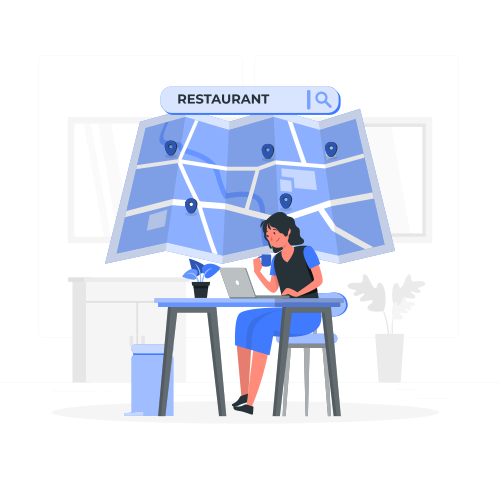
To appear there, you need to:
- Have a website with a working booking engine
- Provide a structured data feed (most PMS platforms like Lodgify or Hostaway handle this automatically)
- Have Google reviews on your Google Business listing
The model is CPC (cost per click) or free depending on your eligibility. For small property managers, Google's "Free Booking Links" program lets you appear in results at no cost.
Strategy 3: Email Marketing and Guest Retention
A guest who stayed with you and was satisfied is your best prospect for a future stay. The problem: if the booking came through Airbnb, you don't have their email. Here's how to work around that limitation:
- The digital welcome book as an email collector: Offer an "exclusive local guide" or a promo code for their next stay in exchange for signing up to your newsletter. It's legal (explicit consent) and very effective.
- Post-stay email sequence: Day 1: thank you and review request. Day 30: newsletter with upcoming events in your area. Day 180: direct booking offer with a discount for "regulars." Day 330: "already a year!" reminder with a special anniversary offer.
- Recommended tools: Brevo (formerly Sendinblue, free up to 300 emails/day) or Mailchimp (free up to 500 contacts). More than enough to get started.
Key stat: a return booking (a guest who comes back) has an acquisition cost of nearly 0 euros, compared to 15-20% in commission for a new traveler through an OTA. Retention is the most profitable lever that exists.
Strategy 4: Social Media and Local SEO
Social media doesn't directly generate many bookings, but they build your local brand awareness and credibility. Focus your efforts on:
- Instagram: Photos of your properties, behind-the-scenes stories of the management business, local recommendations. Local hashtags (#vacationrental + city). 3-4 posts per week is enough.
- Google Business Profile: Create and optimize your Google listing. Respond to every review. Publish "posts" regularly. It's free and is the best local SEO lever available.
- Local SEO: Create pages on your site for each neighborhood or area you cover: "Biarritz city center vacation rental," "Anglet beach apartment." Target long-tail keywords that OTAs don't dominate yet.
Strategy 5: Referral Program
Word of mouth is the most powerful and least expensive acquisition channel. Structure it with a two-sided referral program:
- Guest referrals: Offer 50-100 euros off for both the referrer and the new guest for any direct booking. Real cost: well below the 15-20% OTA commission.
- Owner referrals: Offer one free month of management to any property owner who refers a new signed contract to you. The acquisition cost of an owner client through referral is 5 to 10 times lower than cold outreach.
A Realistic Goal: 20-30% Direct Bookings in 12 Months
Don't aim for 100% direct overnight. OTAs remain useful for visibility and filling vacancies, especially in low season. A realistic goal for the first year:
- Months 1-3: Set up your website, Google Business, and first email collection. Goal: 5% direct.
- Months 4-6: First email campaigns, SEO optimization, Google Vacation Rentals. Goal: 10-15% direct.
- Months 7-12: Guest retention, referrals, regular content. Goal: 20-30% direct.
ROI: How Much You Actually Save
Take a property manager with 150,000 euros in annual revenue through OTAs. With an average commission rate of 17%:
Current commissions: 150,000 euros x 17% = 25,500 euros/year
With 25% direct bookings: 112,500 euros through OTAs (19,125 euros in commissions) + 37,500 euros direct (0 euros in commission) = 19,125 euros in commissions
Annual savings: 6,375 euros
Tool costs: website (30 euros/month) + email (0 euros) + Google Business (0 euros) = 360 euros/year
Net gain: approximately 6,000 euros/year
6,000 euros in additional margin without acquiring a single additional property. And that gain grows each year as your loyal client base expands. At 40% direct, the savings exceed 10,000 euros/year.
The Mistake to Avoid
Never abruptly cut your OTA listings to "force" direct bookings. OTAs remain your source of new guests. The winning strategy is to convert OTA guests into direct clients for their next stay, while maintaining your visibility on platforms to capture new travelers.
Think of OTAs as a customer acquisition cost. The first stay goes through Airbnb (and you pay the commission). The second stay goes through your website (and you keep everything). It's an investment, not a loss.
📚 To go further: Discover our training on direct bookings to create and grow your property management business. The chapter 13 on direct bookings gives you a detailed week-by-week action plan to reach 30% direct in one year.
Frequently Asked Questions
What percentage of direct bookings should you aim for?
A realistic goal is to reach 20 to 30% direct bookings after 12 months of work. The best property managers reach 40 to 50%, but that requires a continuous investment in digital marketing and retention. Every percentage point gained represents significant savings on OTA commissions.
Do you need a website to receive direct bookings?
Yes, a booking website is essential. It serves as a professional storefront, lets you collect bookings without paying commission, and improves your credibility. Solutions like WordPress with a booking plugin or specialized platforms make it straightforward to set up.
How do you retain guests to get direct bookings?
The most effective techniques are: sending a post-stay email with a discount code, systematically collecting email addresses, a seasonal newsletter with local events, and a referral program. The digital welcome book is also an excellent retention tool with a direct booking link.
📖 Recommended articles
- Automate your property management: the 10 best tools in 2026
- How to find your first 10 property owners in 90 days
- Airbnb property management fees: how much does it cost in 2026?
🔗 Official resources
Ready to launch your property management business?
Create your digital welcome book for free and offer a professional experience to your guests.
Create a welcome book for my guestsRelated articles